
- Places
Cream City Squares
Recreation
Milwaukee, WI
State Region
Southeast
Founded / Started: 1991
Still ActiveCommunities Served
Mixed
Logo:

Since 1991, Cream City Squares has created non-stop recreation, social connection, networking events, and community well-being for Milwaukee area square dancers.

INPUT ALWAYS WELCOME!
We are always looking for photos of the exterior and interiors of Bars and other Places, as well as information about ownership, activities and opening and closing background info about Places. We welcome your input and photos!
The GAMMA experiment
Cream City Squares, Milwaukee’s long-running LGBTQ square dance club, was born with a determination to succeed.
In summer 1990, flyers began appearing in Wisconsin gay bars, LGBT newspapers, and bar guides announcing that a gay square dancing group was forming in Milwaukee. Bob Moore, leader of GAMMA, organized the effort as a way to create a new recreational activity to the community.
The first dances were held at the M&M Club, which donated the use of an upstairs meeting room to the group. The space, however, was small and carpeted, accommodating only about three squares in a tight formation. A local caller -- with no experience calling for an LGBT group -- was hired, and dancers frequently moved between the dance floor and the bar during breaks. As new dancers joined each tip, the caller repeatedly had to reteach the same material.
The result was frustrating and disorganized. After three weeks, attendance had dwindled to a single square, and the group could no longer afford to pay the caller. GAMMA's gay square dancing days were over.
Cream City Squares
In summer 1991, Joe Frazier, a former member and teacher with San Francisco's Foggy City Squares, moved to Wisconsin. When he learned the GAMMA effort failed without an experienced caller, he offered to teach the new group himself.
Frazier volunteered his time, taught for free, and got the new club established, despite living about an hour north of Milwaukee. Moore invited former dancers to return for a new series starting in October 1991.
The first open dances were held October 20 and October 27, 1991. The club’s first basic square dance class began November 3, 1991 with 10 students who paid $40 to register.
Cream City Squares recognizes October 20, 1991 as its founding date.
Unlike Moore’s original vision, Cream City Squares wanted to create a club open to both men and women. Moore initially suggested “GAMMA Squares,” while other ideas included “Beer Town Squares,” a reference to Milwaukee’s brewing heritage. The dancers ultimately wanted a name that connected them directly to their city.
They chose Cream City Squares, honoring Milwaukee’s historic nickname, and quickly developed an identity of their own.
Building a community
Joe Frazier taught the first four classes and helped establish the club’s foundation. Because the group had few experienced dancers, the early classes were demanding. The first class had no “angels" -- experienced dancers who assist newcomers -- and everyone needed to attend each week to keep the class moving forward.
Eight dancers graduated from the first class on May 16, 1992, at a large church hall. The club invited members of other gay square dance clubs, including Chicago’s Chi-Town Squares, to celebrate the occasion.
A second class followed, and the club continued to grow. Frazier began training Don Dilges as a backup teacher in winter 1993 because inclement weather affected his commute to Milwaukee. Dilges eventually became one of the most important figures in the club’s history.
Members traveled to other LGBTQ square dance clubs and incorporated the styling they encountered into their dancing. Many Cream City Squares members became comfortable dancing both traditional “girl” and “boy” roles, a practice the club came to embrace as part of its identity.
In 1992, Cream City Squares officially joined the International Association of Gay Square Dance Clubs (IAGSDC) at the organization’s convention in Albuquerque. Randy E., a member of the first graduating class, was the club’s first representative at an IAGSDC convention.
That same year, many members traveled to Chicago for Crossfire IV, an IAGSDC fly-in. The experience helped connect Cream City Squares to a larger national network of LGBTQ square dancers.
A space of their own
Cream City Squares initially danced in Milwaukee’s gay bars, but finding a suitable space remained an ongoing challenge.
After M&M’s, the club moved to 3B’s, a country bar with a wood dance floor that provided more space and hosted line and two-step dancing. The club danced and held classes at 3B's for many years. Members also performed square dance demonstrations during the bar’s country nights.
When 3B’s moved to a smaller 2nd Street location in 1996, conditions deteriorated. The new space had concrete floors, poor lighting, and frequent scheduling conflicts with drag shows. Eventually, dancers were forced into increasingly cramped areas of the bar.
Cream City Squares briefly moved to Just Us, another Milwaukee gay bar with a better wood dance floor. But football broadcasts and other Sunday activities created new conflicts. On June 28, 1998, members arrived for their regular dance and discovered that the bar had closed without warning.
After several difficult years of searching for space, the club found a lasting home at Lake Park Lutheran Church in July 1998.
The church offered a large dance hall and, importantly, an alcohol- and smoke-free environment that appealed to many members. Although the move created a quieter and healthier setting, it also made recruiting more difficult because the club was no longer visibly dancing inside an LGBTQ bar.
A temporary move to Plymouth Church in 2005 was necessary while Lake Park Lutheran underwent renovations. After several months, including some frustrating scheduling problems, Cream City Squares returned to Lake Park Lutheran and continued dancing there.
Teaching the next generation of dancers
Cream City Squares’ longevity depended heavily on its commitment to teaching.
Frazier taught the club’s early classes, while Dilges gradually took on more teaching responsibilities. Dilges became the club’s regular caller after attending the Gay Callers Association Caller School in Chicago during the 1995 IAGSDC convention.
He ultimately taught 18 classes for Cream City Squares, producing 41 graduates.
The club experimented with different approaches to recruiting and training new dancers. When no one enrolled in a planned mainstream class in 1999, members reconsidered the $40 upfront fee. The club began charging dancers $3 for each lesson instead. In 2002, it moved to two shorter 11-week classes each year rather than requiring a longer commitment.
Attendance was often modest. Over the years, the club averaged only about three students per class and developed a philosophy of teaching anyone who showed up—even a single student. Dedicated callers and experienced “angels” helped keep the program going.
The club also expanded its plus dancing. Although Frazier initially wanted Cream City Squares to remain a mainstream club until it became larger, members who attended IAGSDC fly-ins wanted opportunities to dance at the Plus level. Dilges eventually offered plus workshops and classes, including a formal 11-week Plus class in 2009.
Performing at PrideFest Milwaukee
From 1992 onward, Cream City Squares became a regular presence at PrideFest Milwaukee, participating in nearly every festival through the club’s history.
Early demonstrations sometimes featured recorded calls. Later, Dilges led demonstrations and taught festival attendees basic square dance calls. The club eventually moved from the entertainment area to PrideFest’s health and wellness area, where members could demonstrate square dancing and invite newcomers onto the floor.
Cream City Squares also participated in numerous other LGBTQ and civic events.
In 1993, the club formed an Exhibition Team under Frazier’s direction. Members practiced several nights a week to perfect their routines and performed at Milwaukee LGBTQ community events, including a Mardi Gras celebration, a Country Dance fundraiser for the Milwaukee Counseling Center and a Metropolitan Community Church hoedown.
The team also performed at the MAGIC Picnic in Madison and an AIDS fundraiser in Aztalan in 1994.
The club continued supporting community fundraisers for years. In 2006, Cream City Squares co-sponsored “Dance for a Fair Wisconsin” with Mona Bar, raising money for Fair Wisconsin’s efforts related to a proposed state constitutional amendment concerning same-sex marriage and civil unions. In 2009, the club participated in a Cream City Foundation Coming Out Day event.
Bridging the wider communities
One of Cream City Squares’ most significant contributions was its relationship with Milwaukee’s broader square dance community.
The club first participated in the Wisconsin State Square Dance Convention in Milwaukee in 1993. Its members arrived nervous about how they would be received, but their dancing quickly attracted attention.
Cream City Squares danced together as a single square and incorporated the styling they had learned from other LGBTQ clubs. Their performance drew spectators, including people who had never before seen a square composed primarily of men dancing together.
The dancers also demonstrated their technical skill. During one Mainstream tip, Cream City Squares completed a difficult call successfully while other squares broke down. The caller approached the group afterward and offered her card in case they ever wanted to hire her.
The experience helped break down barriers between LGBTQ and predominantly straight square dance communities. Cream City Squares members subsequently attended Wisconsin State Square Dance Conventions and local straight-club dances, where they were increasingly welcomed.
In 1995, the club received a Group Spirit Certificate of Merit at the Human Rights League for Lesbians and Gays Cream City Brick Awards. The recognition specifically honored the group for helping bridge the gap between Milwaukee’s LGBTQ and straight communities at a time when many LGBTQ organizations remained largely within their own community.
Cream City Squares became an active participant in the national IAGSDC community, attending conventions and fly-ins across the country.
Ten members traveled to the 1993 IAGSDC convention in Seattle—the largest contingent the club would ever send to an IAGSDC convention in a single year. Members also participated in regional fly-ins, including Chicago’s Great Chicago Crossfire.
The club hosted several one- and two-day “drive-ins” during its first five or six years, inviting nearby clubs to Milwaukee for dancing and potluck meals. Chi-Town Squares sometimes arrived by bus with as many as 50 dancers.
Cream City Squares considered eventually hosting a full fly-in but never did. Its relatively small membership, limited housing capacity and the demands placed on the volunteers who organized events made such an undertaking difficult.
Evolving and advancing the mission
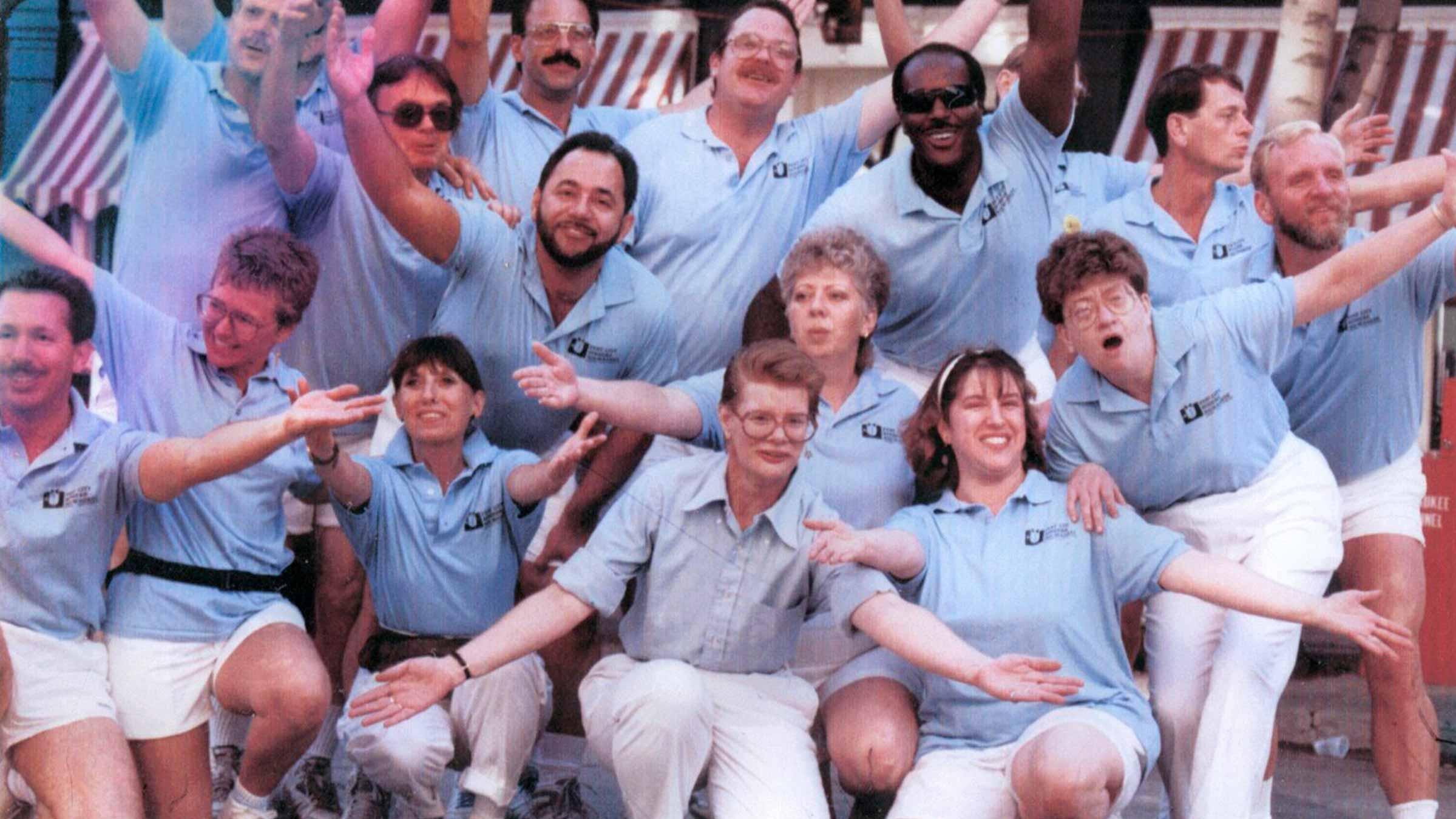
Cream City Squares evolved considerably from its beginnings as a group of gay men. Over time, the membership included gay men, lesbians, transgender dancers and straight couples. Members brought different approaches to square dancing, including bidansual dancing (the ability to dance both traditional roles, male and female.)
The club became known for its styling, its willingness to explore both mainstream and plus dancing, and the friendships that developed beyond the dance floor.
At its height, the club might have had roughly 22 people attending dances, although the number of paid members was smaller. Even with modest membership, the group remained committed to keeping the dances going. Only rarely did attendance fall below the number needed to form a square.
Longtime members included Joe Frazier, James T. and Don Dilges, who remained continuously involved from the club’s beginning. Richard B. began dancing with the club during its second class.
Cream City Squares also adapted to changes in how Milwaukee’s LGBTQ community communicated.
The club published a newsletter beginning in 1994, initially produced by Trig S. and later maintained by Don Dilges. The newsletter kept members informed about dances, classes, special events, IAGSDC conventions and fly-ins.
As the internet became more important, the newsletter was discontinued. Dilges established the Cream City Squares public website in 2001 and moved it to IAGSDC-hosted space in 2002.
The website became an important recruiting tool, particularly as Milwaukee’s LGBTQ newspapers and bar guides disappeared. Members also maintained a private online space where they could share photographs, meeting minutes, bylaws and club information.
Cream City Squares became a member club of the local Wisconsin SE Area Association in January 2012.
Lasting legacy
Despite dancing non-stop for 35 years, Cream City Squares has remained a small, tight-knit, and mighty organization. The club continues to offer recreational dance -- in a smoke-free and alcohol-free environment at Lake Park Lutheran Church -- for dance-minded LGBTQ individuals.
INPUT ALWAYS WELCOME!
We are always looking for photos of the exterior and interiors of Bars and other Places, as well as information about ownership, activities and opening and closing background info about Places. We welcome your input and photos!
join our email list
Get WI LGBTQ History Project updates in your inbox.


