
- Places
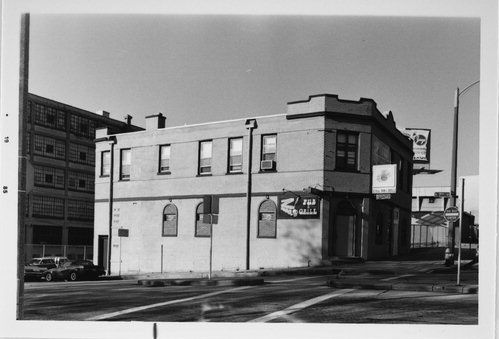
Diplomat Musical Lounge
Bar Cocktail Lounge|Piano Bar|Live Music
701 W. Juneau Ave
Milwaukee, WI 53203State Region
Southeast WI
Neighborhood
Haymarket
Year Opened: 1958-08-01
Year Closed: 1960-03-01Exact Date Opened: Friday, August 01, 1958
Exact Date Closed: Tuesday, March 01, 1960Clientele Primarily Identified As
Gay
Logo:

701 W. Juneau Ave., built in 1916, was a long-time Milwaukee saloon later known as the MATC "Z-Building." In August 1958, the Diplomat Musical Lounge opened here, and was immediately well-known for its high-end cocktails, live piano, amazing sound system, and flamboyant decor. However, the Common Council revoked its license twice under suspicion that it was a homosexual operation. Despite rebranding as the Aristocrat, the bar was eventually ordered to close. This was a significant time in Wisconsin LGBTQ history, when "deliberate gay bars" began to open, welcoming gay customers -- not just tolerating them.

INPUT ALWAYS WELCOME!
We are always looking for photos of the exterior and interiors of Bars and other Places, as well as information about ownership, activities and opening and closing background info about Places. We welcome your input and photos!
Built in 1916 by Gustav Frey, 701 W. Juneau Ave. spent its earliest years as one of the last Pabst Brewing Company tied saloons. After Prohibition and the tied-house ban, the tavern began a 50-year journey through almost endless name and format changes.
During the 1940s, the bar was a popular live music venue called "Thelma's Back Door."
On August 16, 1958, Milwaukee Journal columnist Jim Koconis noted in "Nightlife Chatter" that new owners Ed and Karen Gray had redecorated the old bar in flamboyant colors - purple, orange, white and green -- making a bold -- even loud -- fashion statement. Former customers described the Diplomat Musical Lounge as "peak midcentury kitsch."
Opening a high end cocktail lounge in this neighborhood was a gamble for 1958. At the time, West Juneau Avenue was a tired, rundown and slightly rough stretch of taverns, stretching all the way from Water Street to the Pabst Brewery. In turn, the Milwaukee County Expressway Commission targeted many nearby properties -- even those outside the freeway's path -- for "blight removal."
Thanks to aggressive advertising, the bar was an immediate, tremendous success. Unfortunately, it lost its license within two months. Why?
Police testified that Ed Gray was a resident of Detroit, not Milwaukee, and was allowing "unlicensed persons" to operate the bar. The real story was that the Diplomat welcomed homosexual customers in large numbers -- and police suspected the local operators were "aunties" hired to bring in gay business. (At a time when word of mouth was the only "gay guide," someone sure got the word out to the gay community that a new bar was opening.)
The bar reopened as the Aristocat Musical Lounge in February 1959. However, police soon discovered the new licenseholder was Adam Lisheron, brother of Ed Gray's lawyer, Frank Lisheron. The license was revoked again in January 1960, as the committee "feared a subterfuge operation." On March 1, 1960, the Common Council finally ordered Adam Lisheron to sell the business or lose his liquor license.
The Diplomat / Aristocrat was cited several times for serving diluted liquor-- something commonly done at gay bars of this era, because gay clients were unlikely to complain. When inspectors found three diluted bottles of whiskey during a January 1960 visit, bartender Frank Lisheron was charged $150 for "mixing drinks in the bottle."
The location reopened in July 1960 as Mr. Kelly's, featuring brass jazz bands for several years. It was later known as Gallery Lounge (1961) and Rickey's Yum Yum (1963) with long periods of vacancy in-between and afterwards.
The Flame Nightclub, opened by Derby Thomas in 1946 at 1315 N. 9th St., moved here in April 1964. The liquor license was renewed in July 1964, with the caveat that a 30-day notice could be served if freeway construction was ahead of schedule. Yet, somehow, the property evaded demolition as it was deemed to be "saveable."
Derby Thomas died in October 1964. His widow, Loretta Whyte, chose to reopen The Flame after his death, but it didn't last long.
By November 7, 1965, the Milwaukee Journal commented:
"Until recently, about a dozen taverns operated on the north side of Juneau Ave. between N. 3rd and N. 7th Sts. But Tavern Row on W. Juneau Ave. isn't much of a temptation anymore to the man with a heavy thirst. Most of the small, dimly lit taverns that stood nearly shoulder to shoulder on the north side of the avenue are now dusty, vacant shells waiting to be torn down. Neon lights still twinkle outside a few, but only a few."
"The invasion of freeways accomplished what police crackdowns and the clamor of neighborhood and civic groups could not achieve: a weeding out of the taverns from this area. The land has been taken for the Park Freeway, due to be completed in 1971."
"It was probably the longest block in Milwaukee for the man with a thirst. The area has long been the target of police. Call girls operated from many of the taverns, few of which could ever possibly meet health codes."
But somehow the corner building at 701 W. Juneau survived this round of demolitions, perhaps partly because of its historic status as a Pabst Brewing Company tied house.
By October 1966, the building was again vacant -- and remained vacant until it became Irene's Club Continental sometime in 1969. Irene's was the scene of scandal in August 1972 when three off-duty people officers provoked a disturbance at the bar, made racial remarks and chased and struck an African-American bartender. Operator Irene Spivey Salter was convicted several times, including allowing minors and prostitutes to loiter in the bar, and for being the inmate of a gambling house.
By 1979, the building was a popular MATC hotspot known as "Z Bar," or the Z-Building Pub and Grill. In August 1989, MATC voted to purchase four blocks of land, including the Z-Building Pub, to expand its downtown footprint. Down went the historic Z-Bar, to be replaced with a parking lot.
Curiously, 701 W. Juneau had survived the near-total demoliton of West Juneau Avenue's Tavern Row in the 1960s because of its historic "status" as a Pabst Brewing Company tied house. However, no one came to its rescue in 1989 -- not even one Pabst or historic preservationist.
While brief, the Diplomat/Aristocrat era was a very significant one. The Pink Glove was during this same timeframe and usually gets all the credit for being the first "deliberate gay bar," i.e., a bar that specifically marketed to gay clientele. By all accounts, something similar was going on with the Diplomat as well.
Note: MATC students may remember 701 W. Juneau as the "Z-Building" (1976-1996.)
INPUT ALWAYS WELCOME!
We are always looking for photos of the exterior and interiors of Bars and other Places, as well as information about ownership, activities and opening and closing background info about Places. We welcome your input and photos!
join our email list
Get WI LGBTQ History Project updates in your inbox.


