
- Places
Renaissance of Madison
Activism
Madison, WI
State Region
Central
Founded / Started: 1974
Disbanded / Ended: 1981Communities Served
Mixed
Discover the history of Renaissance, a groundbreaking LGBTQ organization that provided community services, health care, advocacy and support in Madison throughout the 1970s.

INPUT ALWAYS WELCOME!
We are always looking for photos of the exterior and interiors of Bars and other Places, as well as information about ownership, activities and opening and closing background info about Places. We welcome your input and photos!
Renaissance of Madison was one of the early organizations that helped build Madison's LGBTQ community infrastructure in the 1970s. Like Milwaukee's Gay Peoples Union (GPU), Renaissance combined community organizing with practical services, including a community center, peer counseling, health services, legal referrals, educational programs and information resources.
Renaissance emerged from Madison's rapidly developing gay liberation movement. Crossroads of Madison, which had been incorporated in 1972, established the city's Gay Center that same year. The center moved several times before settling at St. Francis House Episcopal Student Center at 1001 University Avenue in 1974. That year, Crossroads merged with Renaissance of Madison, which was incorporated as a nonprofit organization.
The surviving historical record suggests that 1974 is the most reliable date for Renaissance's formal incorporation, although references in Renaissance publications sometimes point to earlier community work. An October 1975 treasurer's report stated that it was the organization's "first year of operation" and that operations had begun in October 1974. At the same time, a May 1976 newsletter described Renaissance as having established a foundation of services over the previous five years. That earlier reference may have reflected the history of the Gay Center and organizations that preceded Renaissance rather than the formal founding of Renaissance itself.
Renaissance continued operating the Gay Center, which served as a central gathering place and resource hub for Madison's LGBTQ community. The center provided office and meeting space, a telephone information service, a periodical library and space for other community organizations and projects.
The center was also part of a broader network of organizations that used St. Francis House as a base. The building had already played an important role in Madison LGBTQ history: the Madison Alliance for Homosexual Equality (MAHE), Wisconsin's first organization to publicly advocate for LGBTQ civil rights, held its first gathering there in 1969. Over the following years, St. Francis House became an important meeting place for Madison's emerging gay liberation movement.
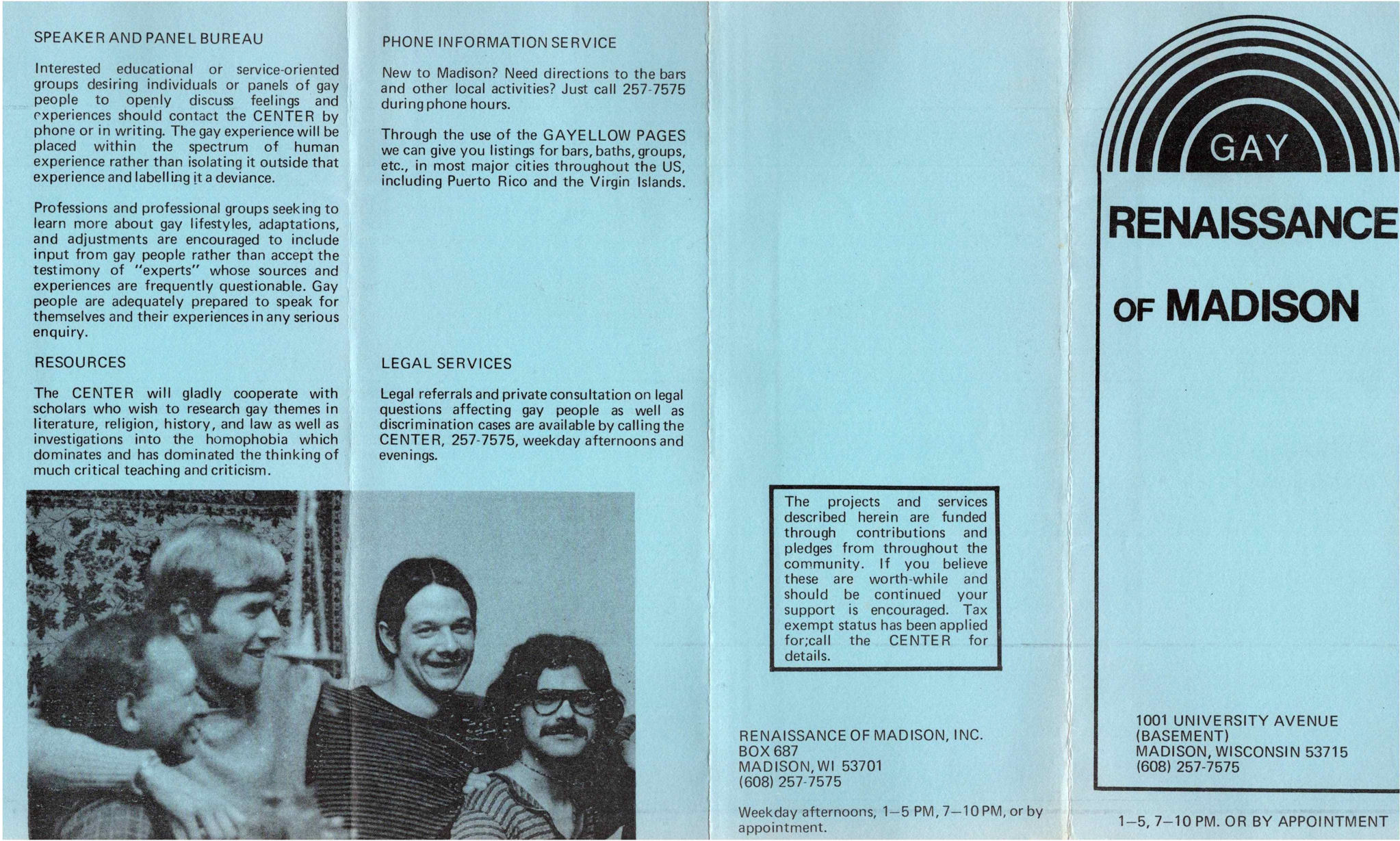
Renaissance's February 1975 informational material described the organization as a Madison-based, nonprofit, service-oriented organization whose purpose was to raise money for gay community projects and services. Its board consisted of community members committed to promoting what the organization called "a positive and integrative concept of and for gay people."
Among its services were:
- Peer counseling: Renaissance offered free peer counseling for people dealing with loneliness, isolation, relationship difficulties and other concerns. The organization emphasized that counseling was not limited to people experiencing severe emotional problems.
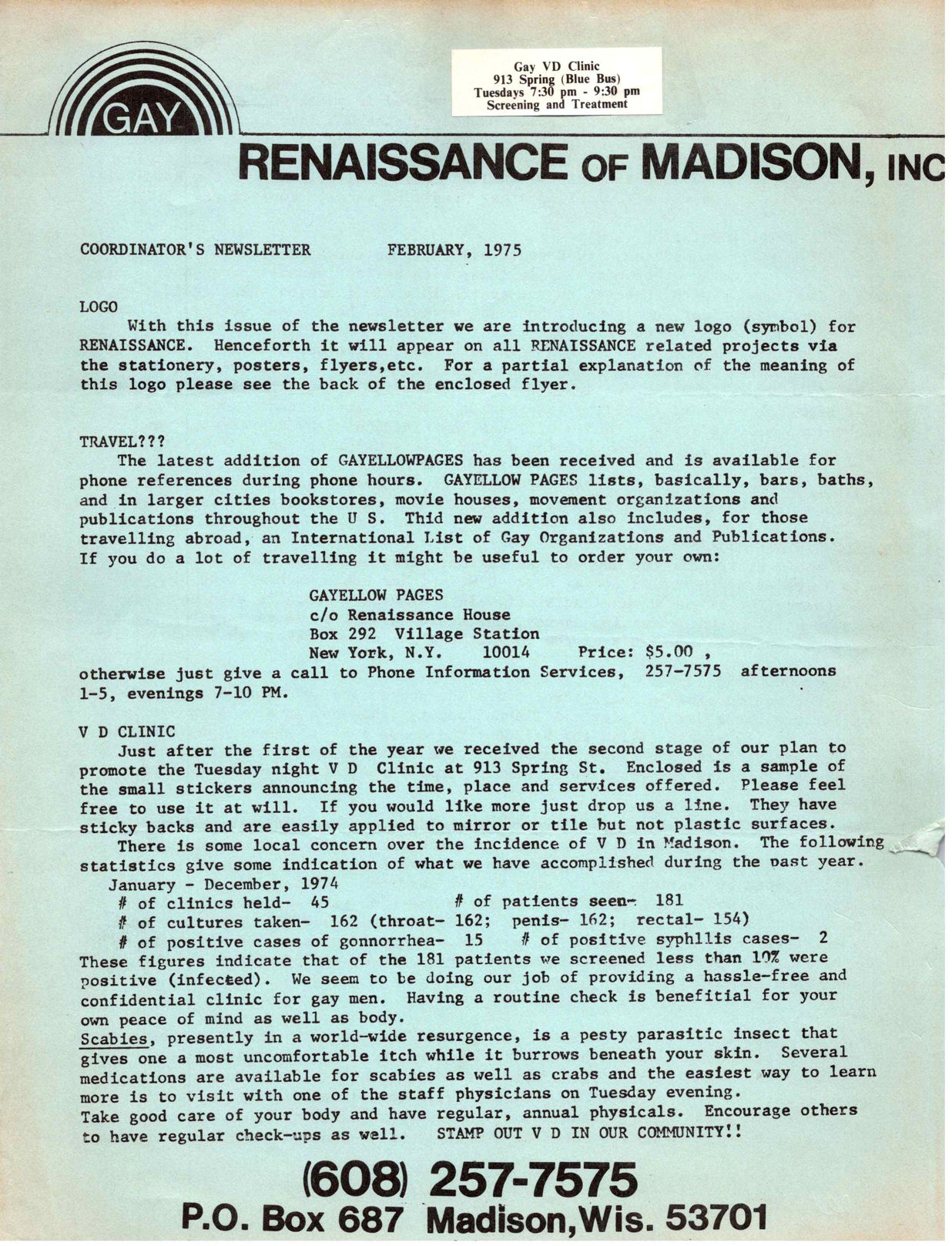
- Gay VD Clinic: The organization operated a clinic offering screening and treatment for venereal disease. The clinic had begun with screening in 1973 and later expanded to include treatment. By 1975, the clinic was listed at 913 Spring Street and operated on Tuesday evenings.
- Speaker and Panel Bureau: Renaissance connected schools, professional organizations and community groups with LGBTQ speakers and panels. Its materials emphasized the importance of allowing gay people to speak about their own experiences rather than relying solely on outside "experts."
- Telephone information service: The center provided information about local organizations, social activities and other community resources.
- Legal referrals: Renaissance offered referrals and private consultations concerning legal issues affecting gay people, including discrimination.
- Research resources: The center encouraged scholars researching homosexuality and LGBTQ themes in literature, religion, history and law to use its resources and connect with members of the community.
- Community information: Renaissance maintained access to Gayellow Pages, allowing Madison residents to obtain information about LGBTQ organizations and businesses in other cities.
The organization's materials also promoted the Gay Activist's Alliance (GAA) at the University of Wisconsin, describing it as a student organization serving the educational, social and political needs of gay students. The GAA was open to people beyond the student community as well.
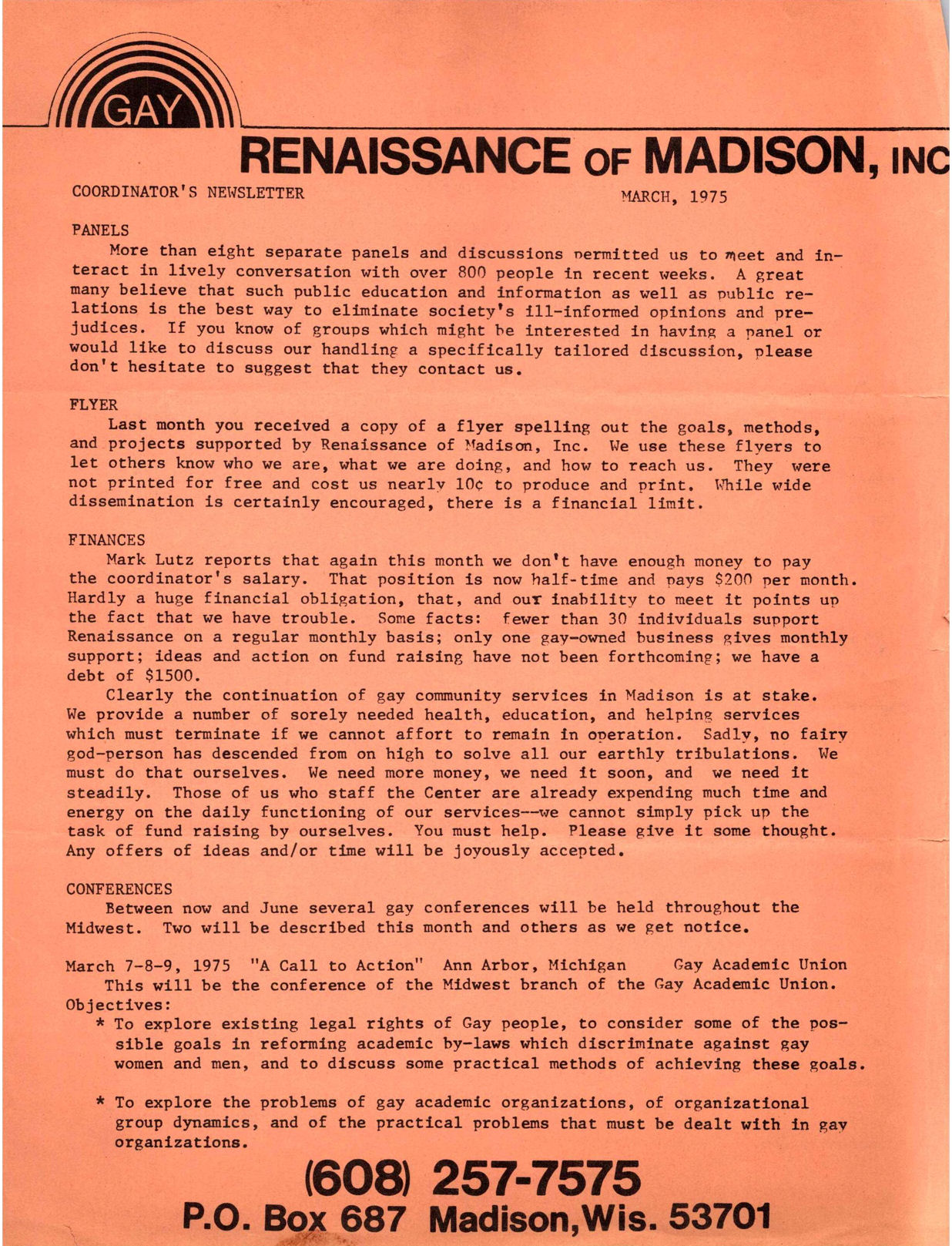
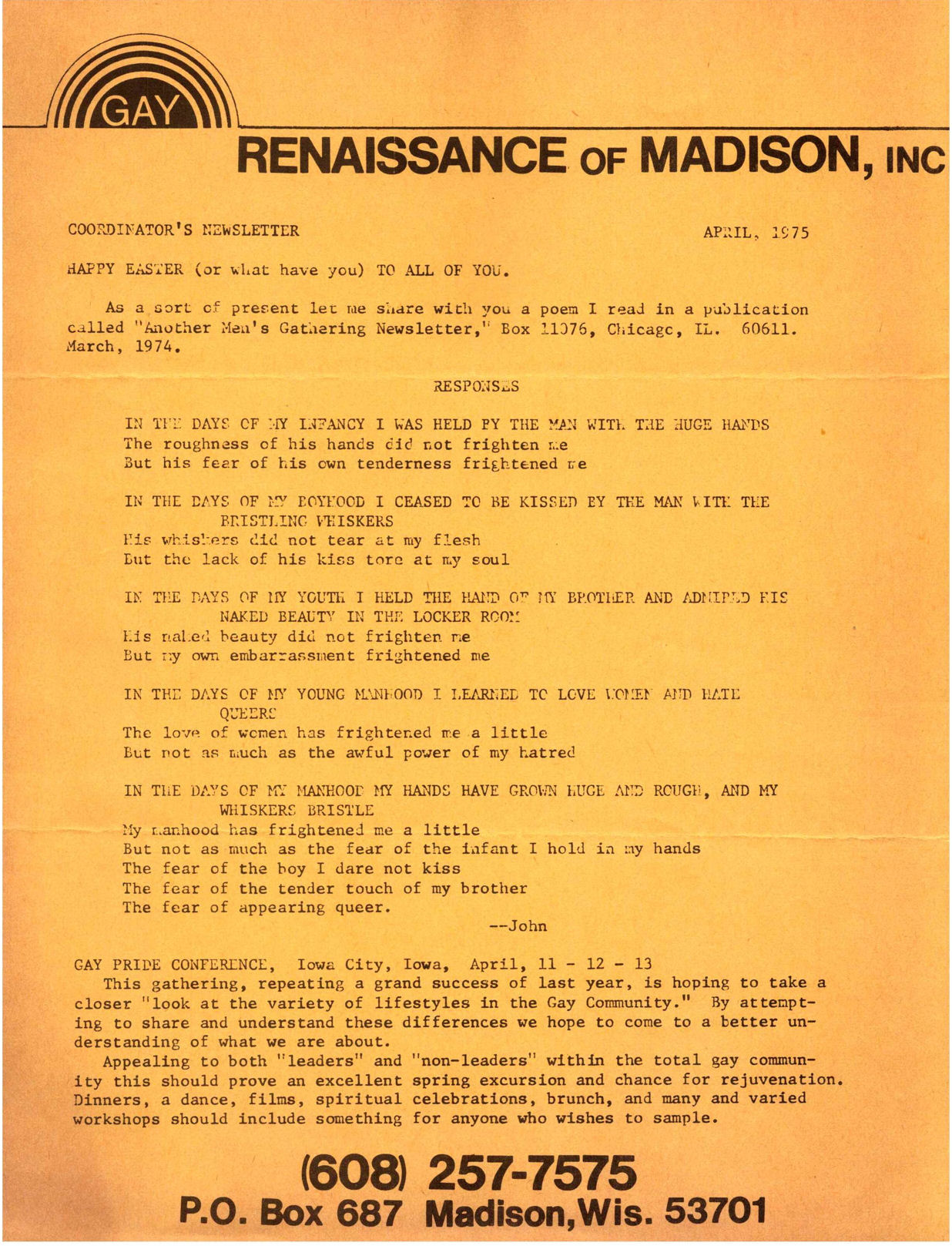
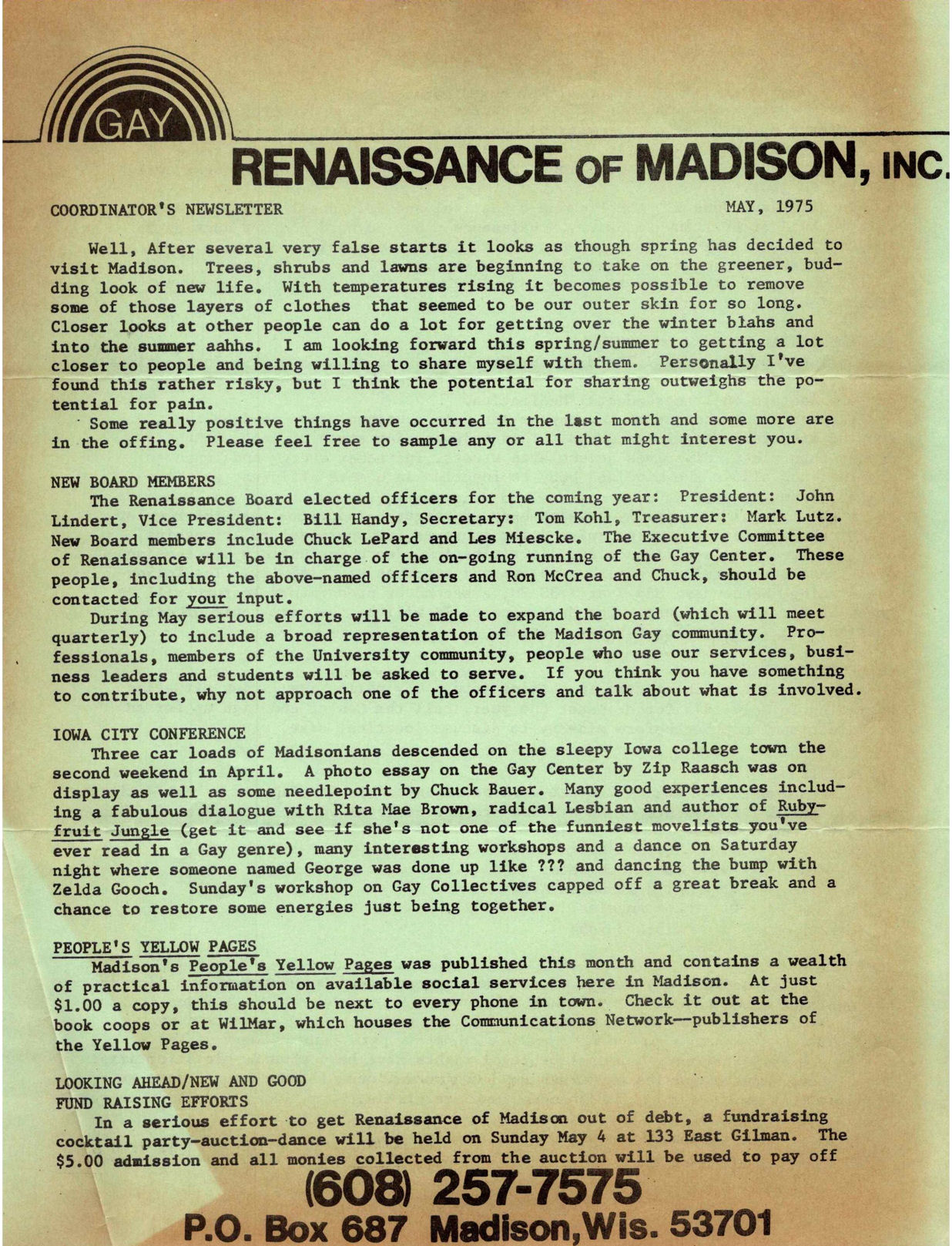
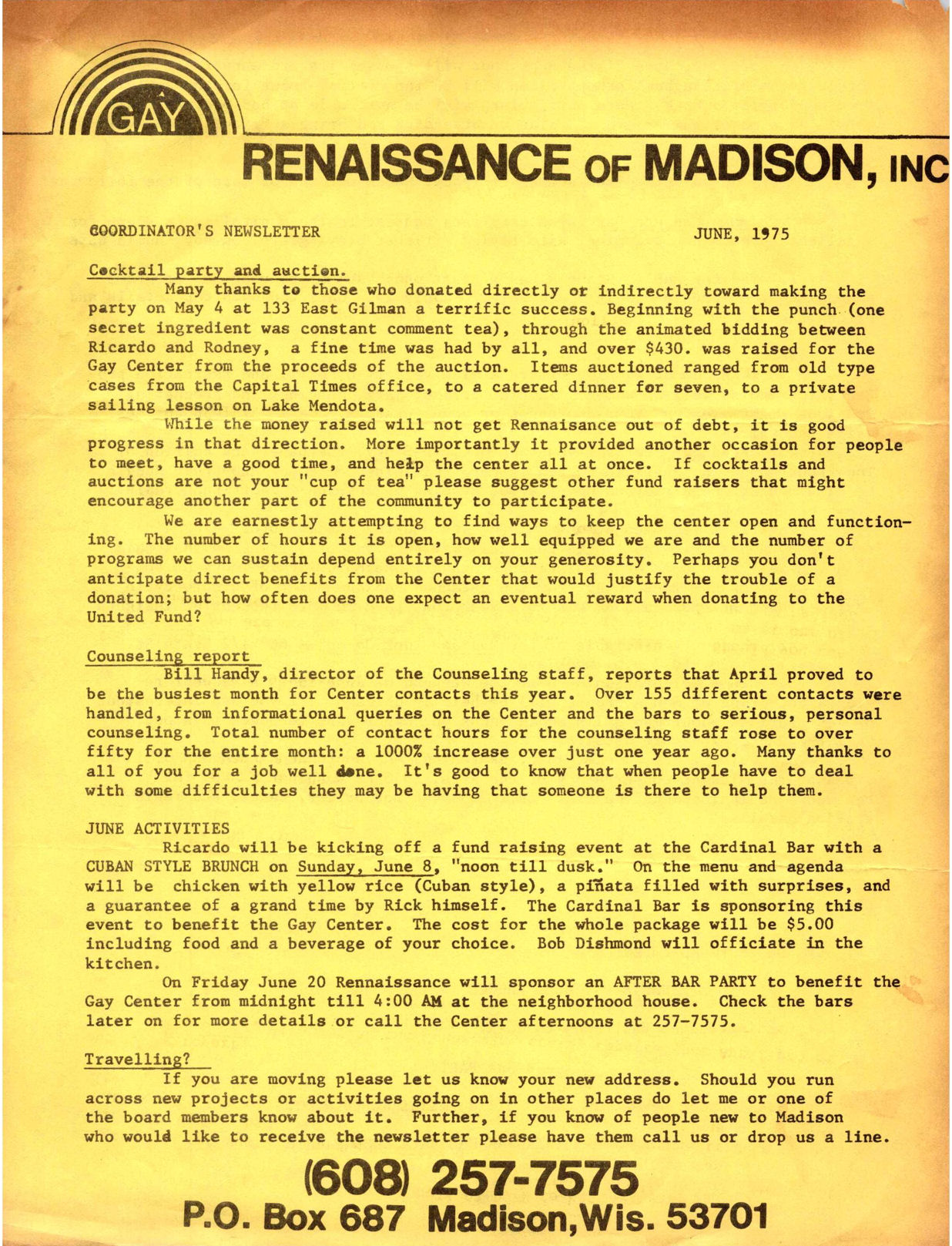
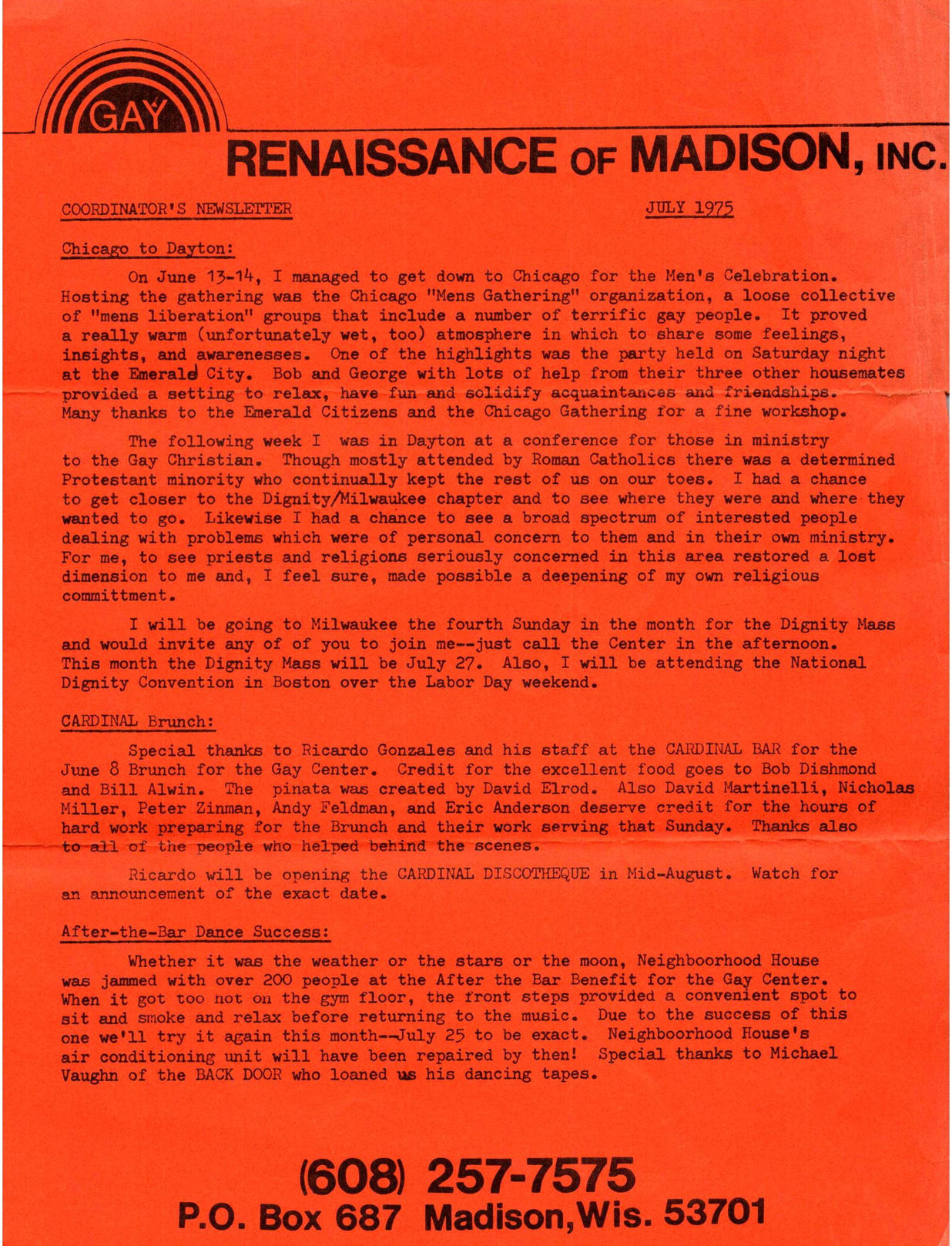
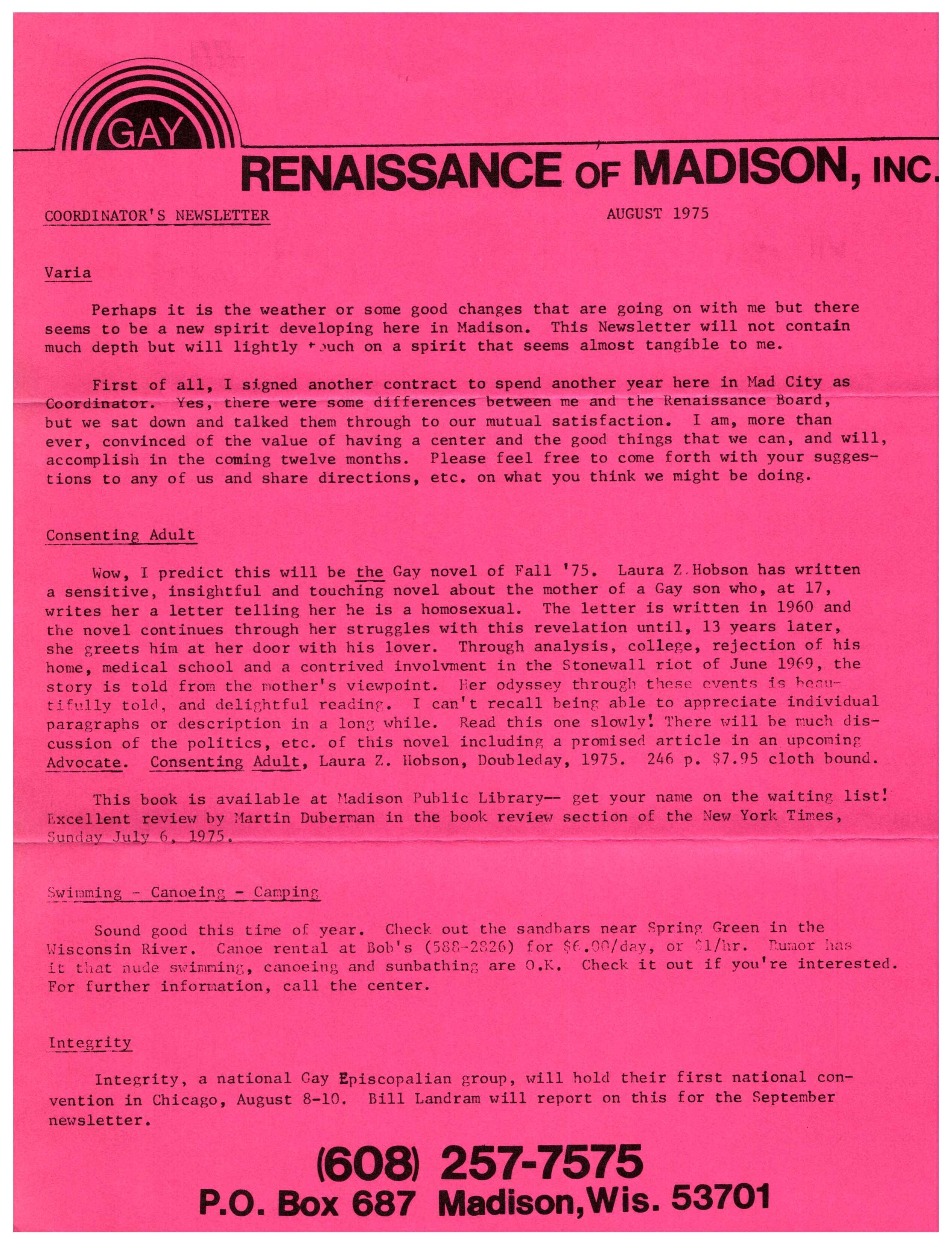
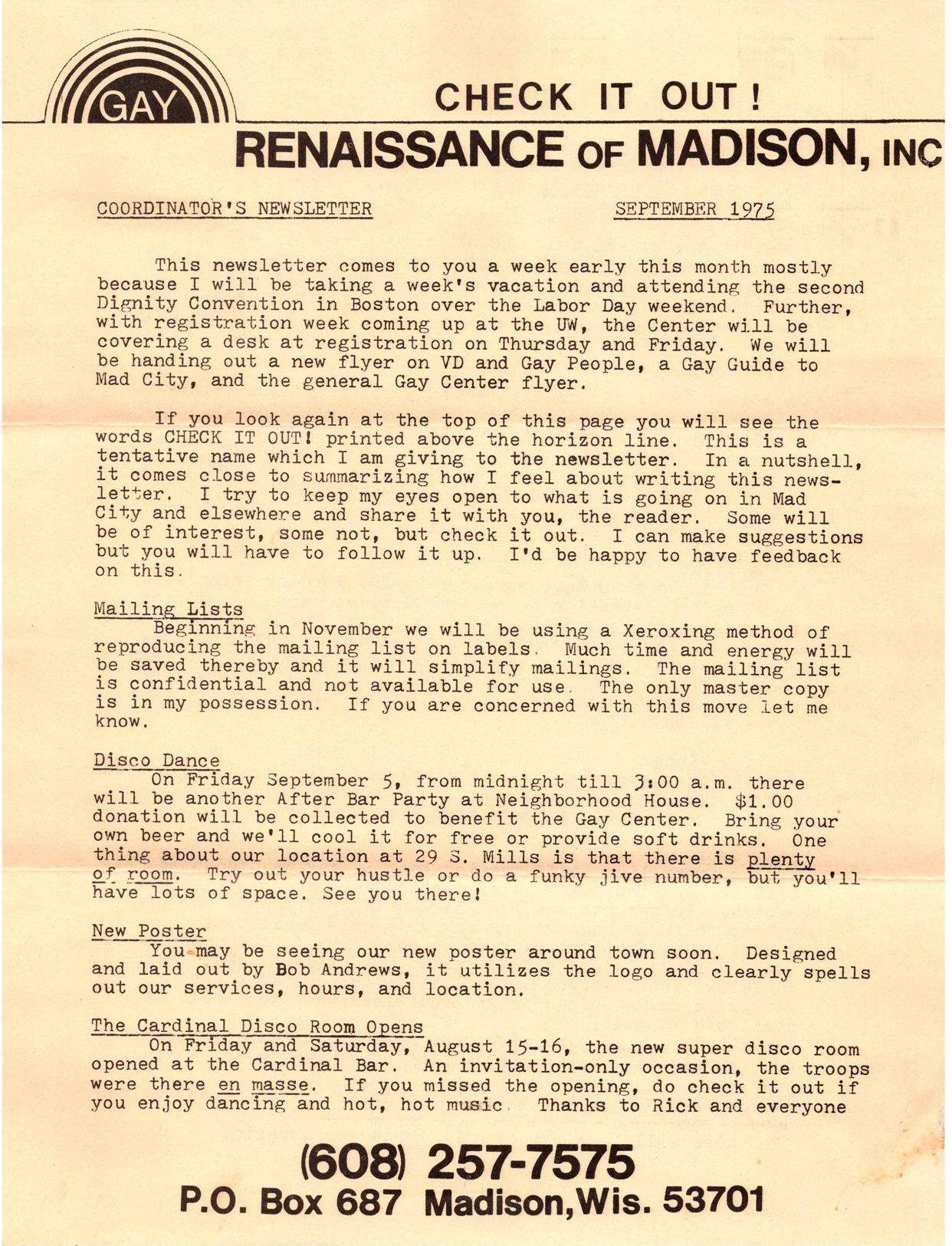
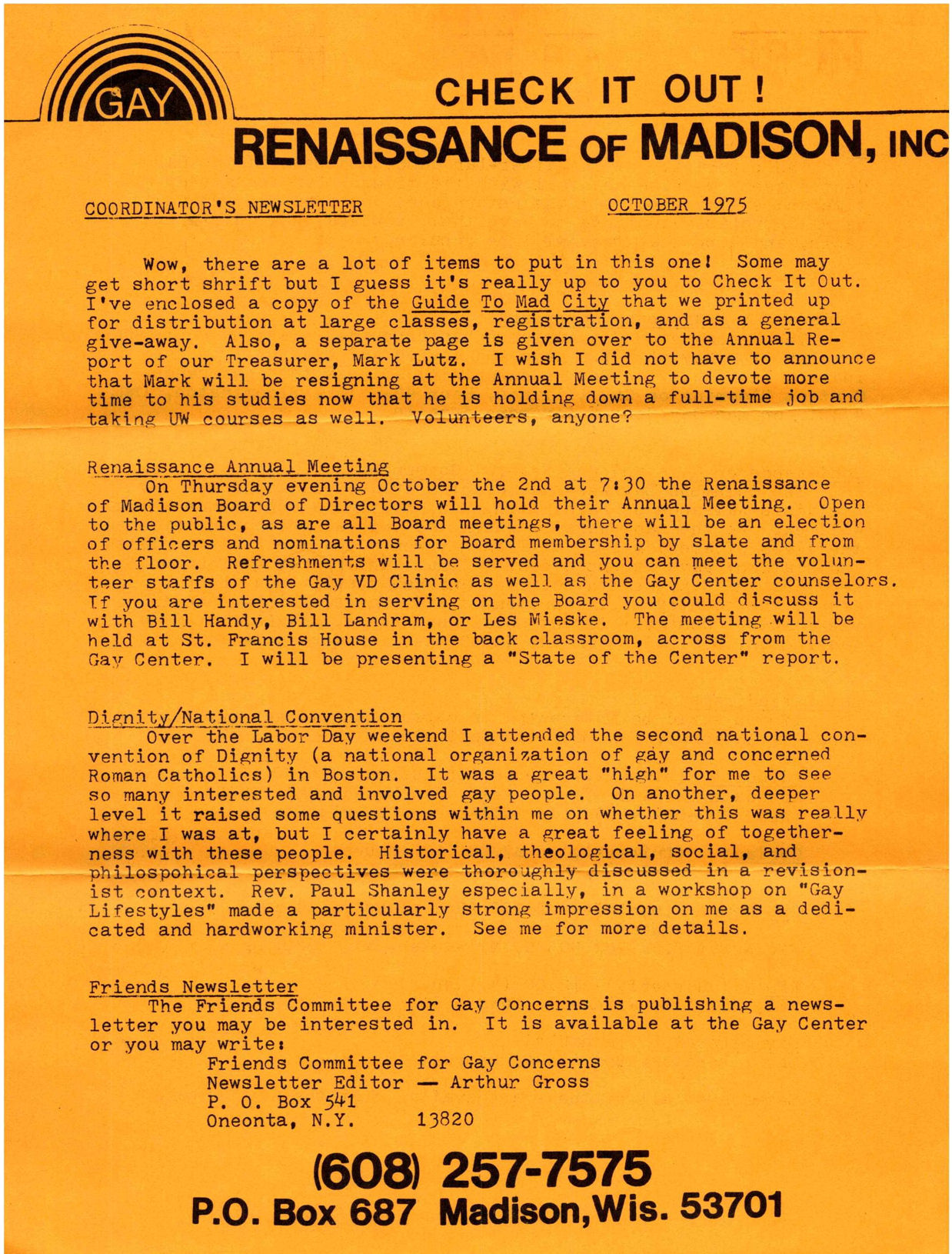
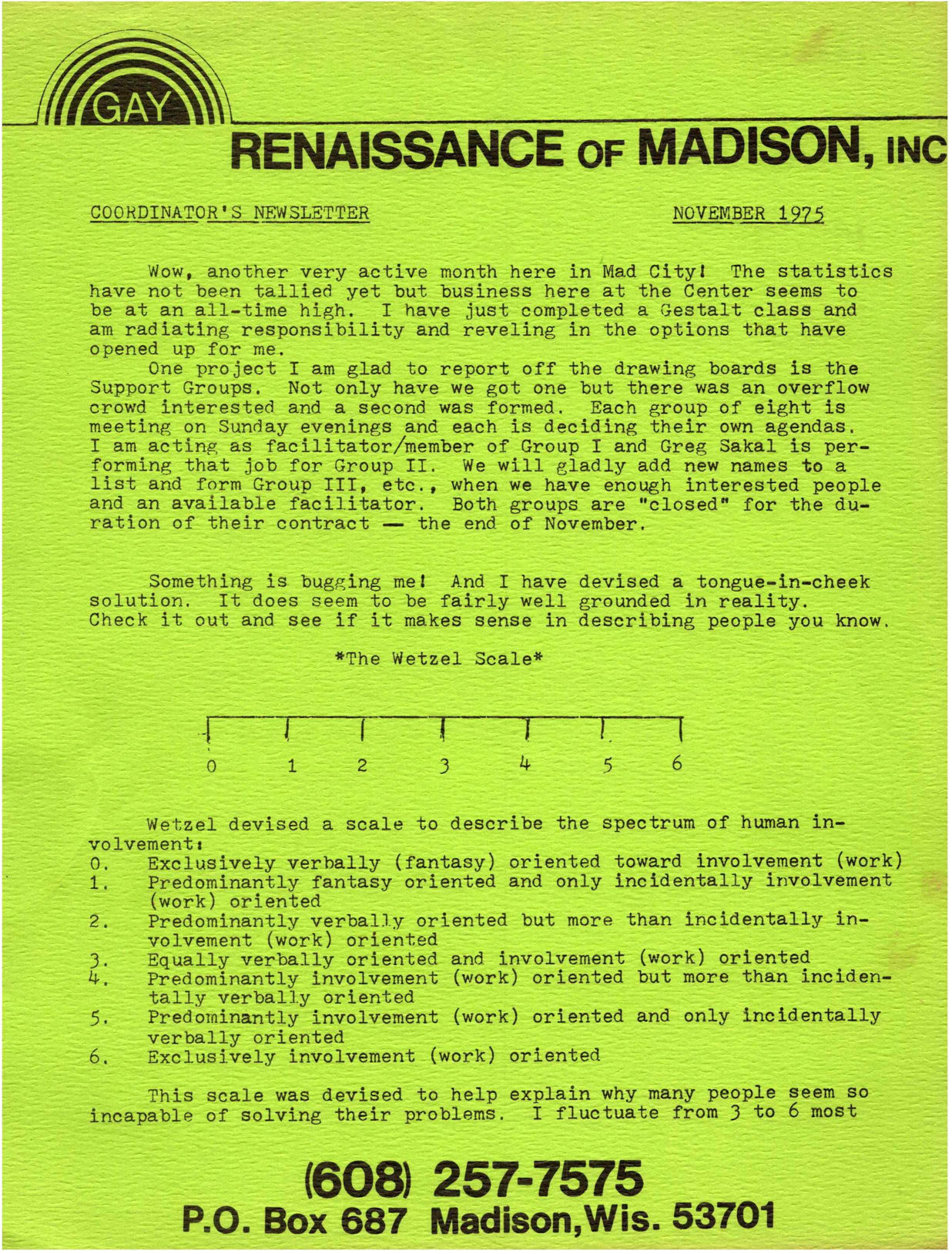
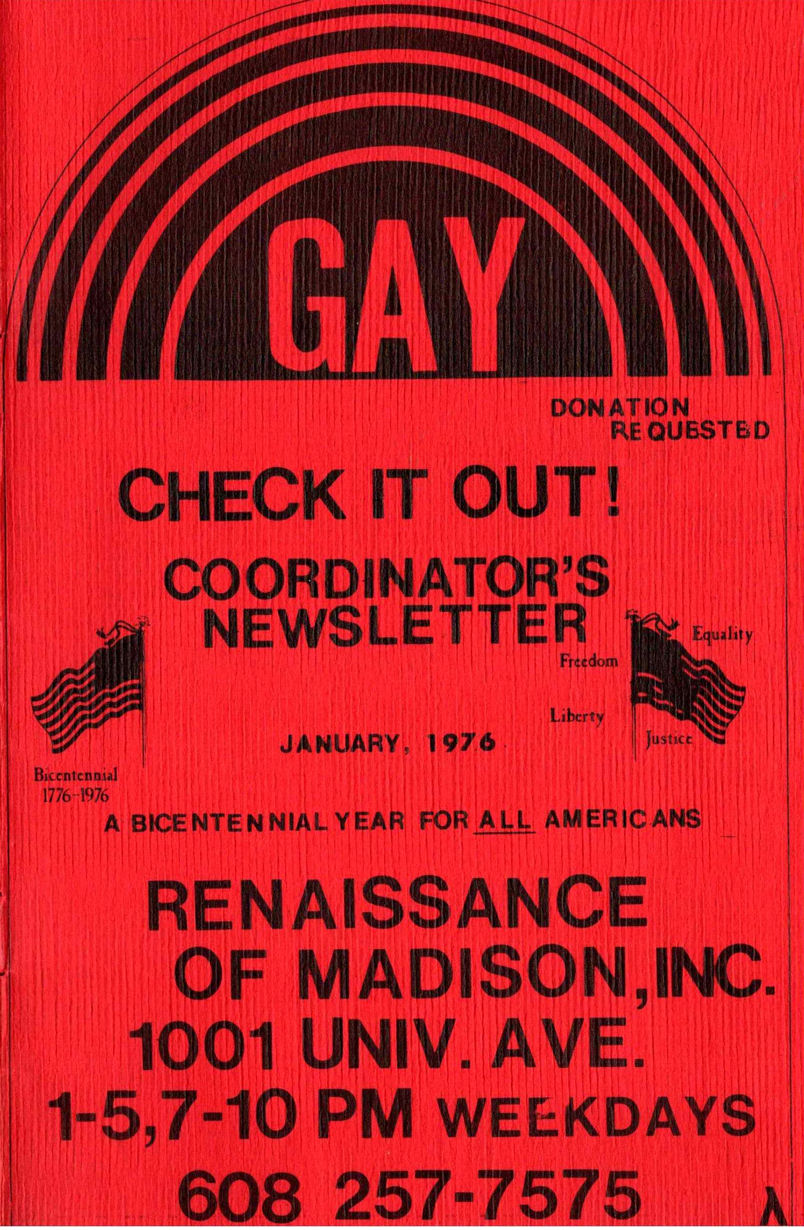
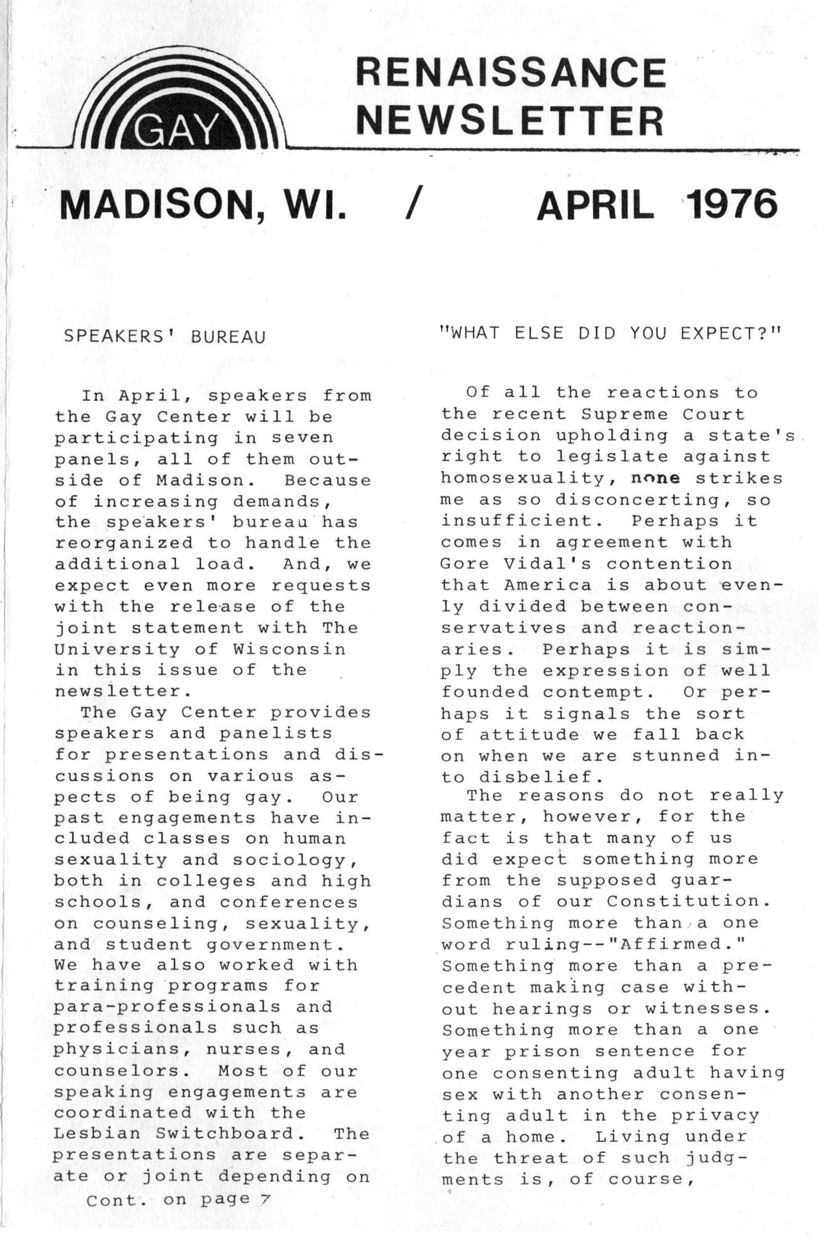
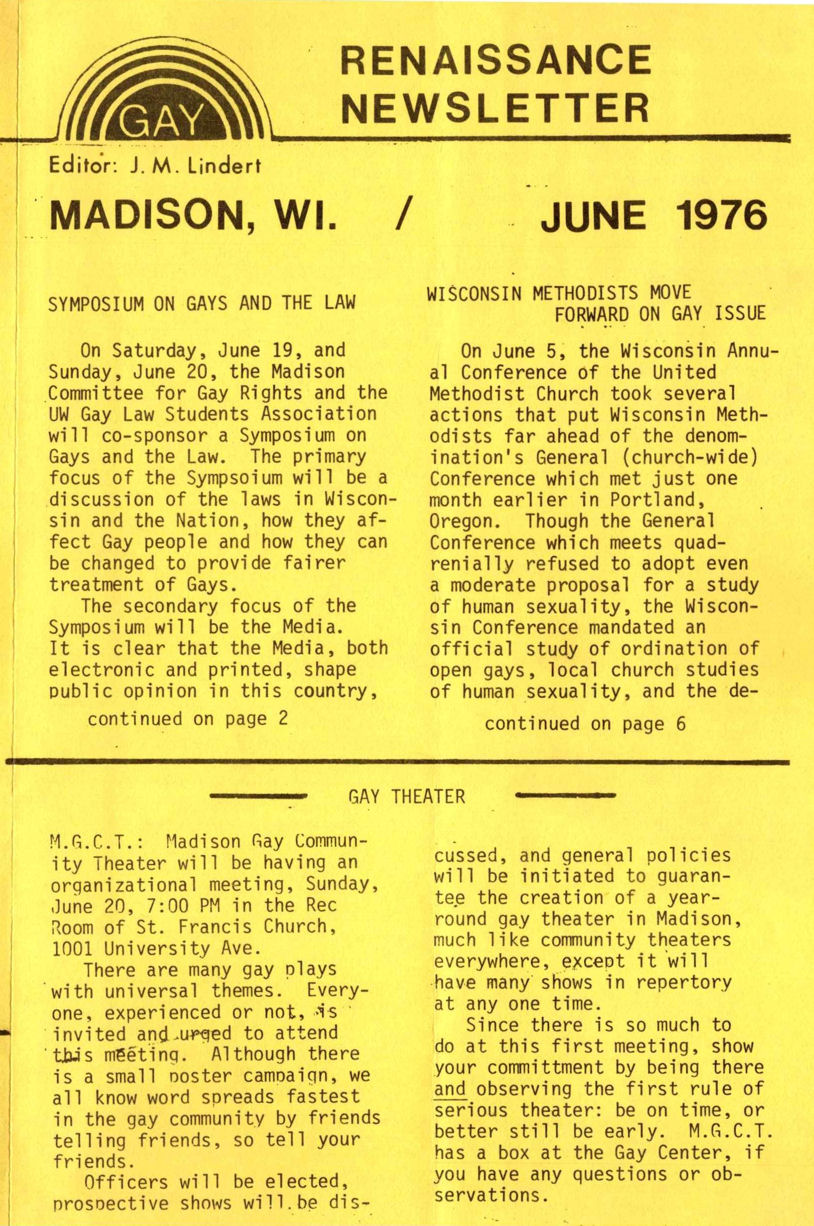
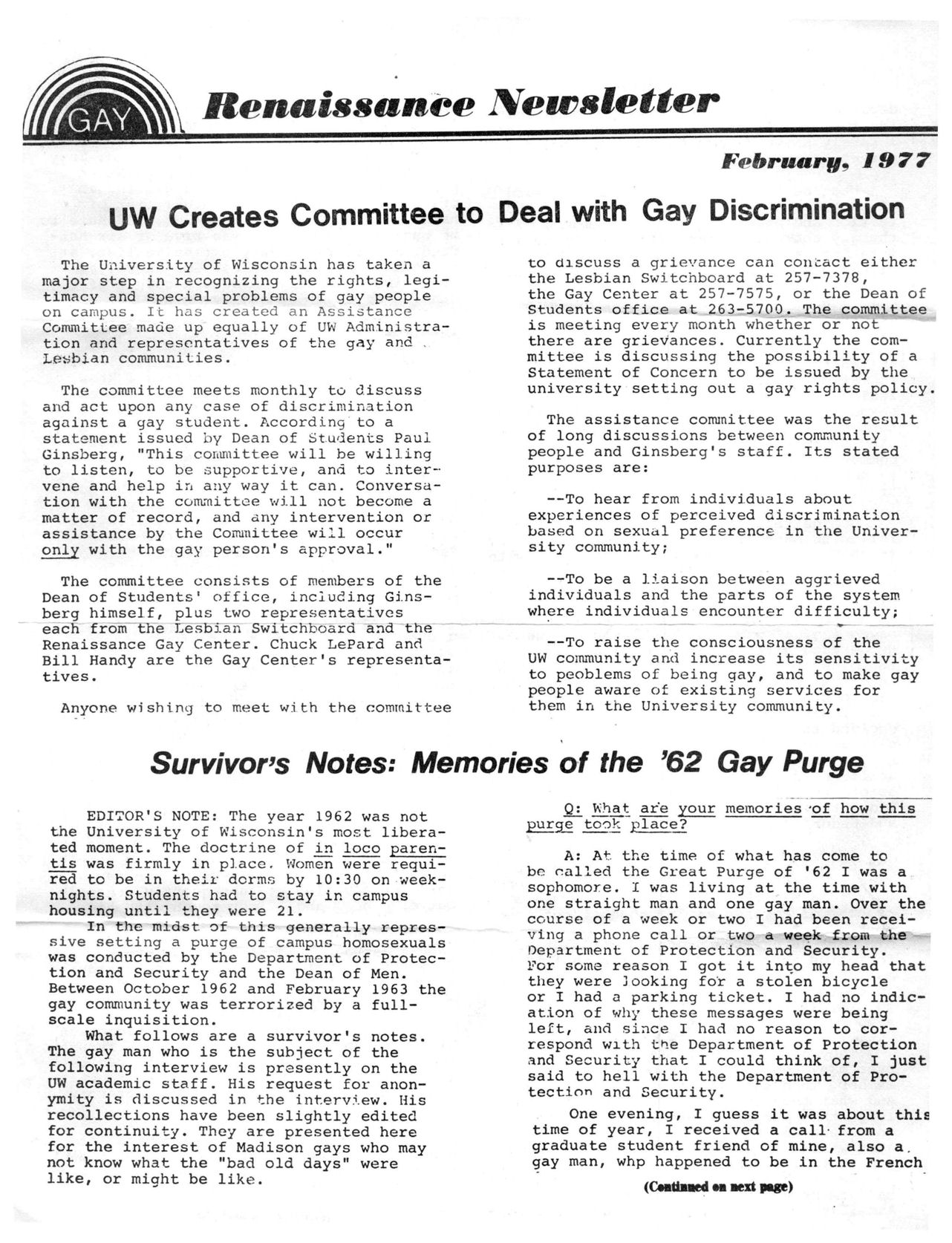
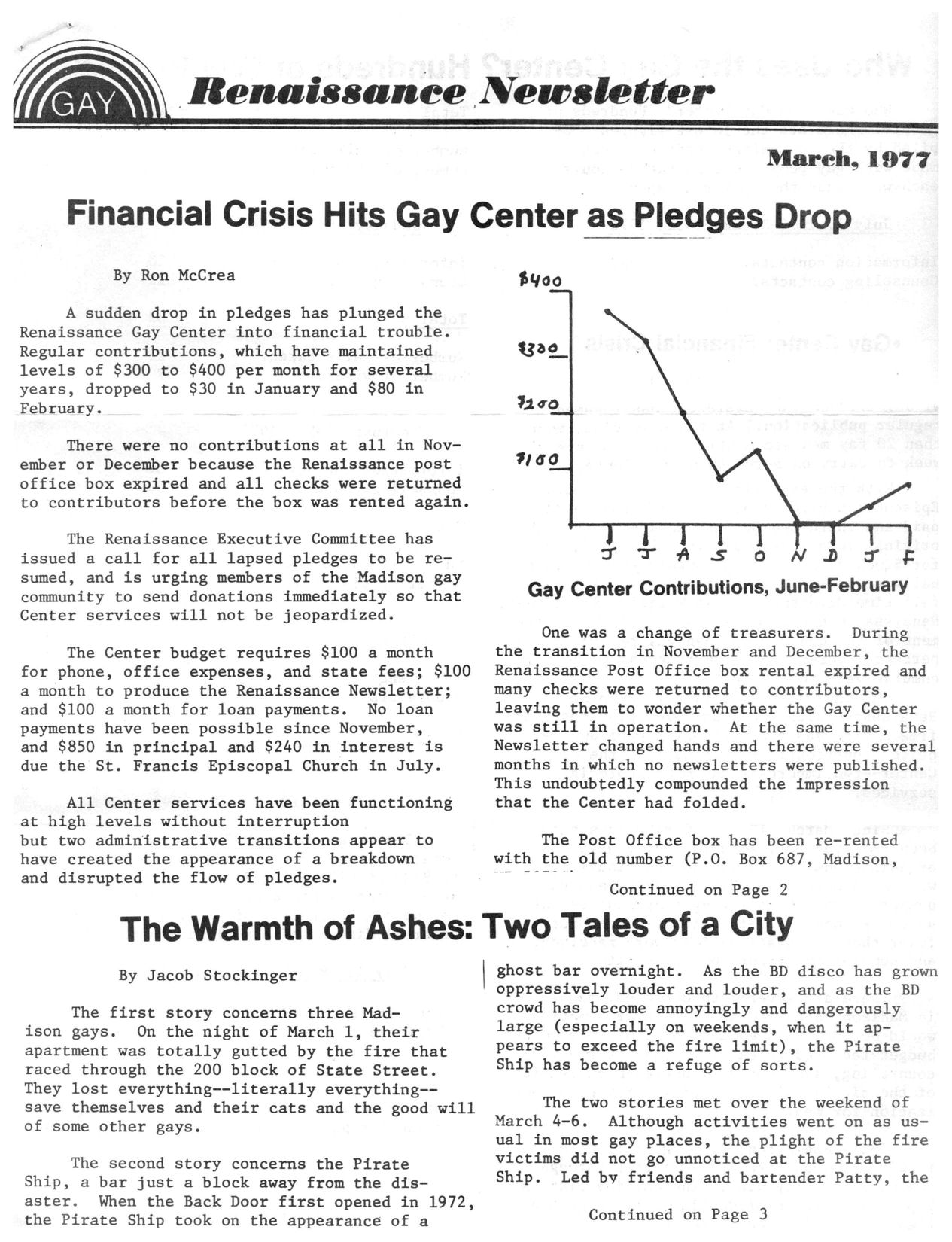
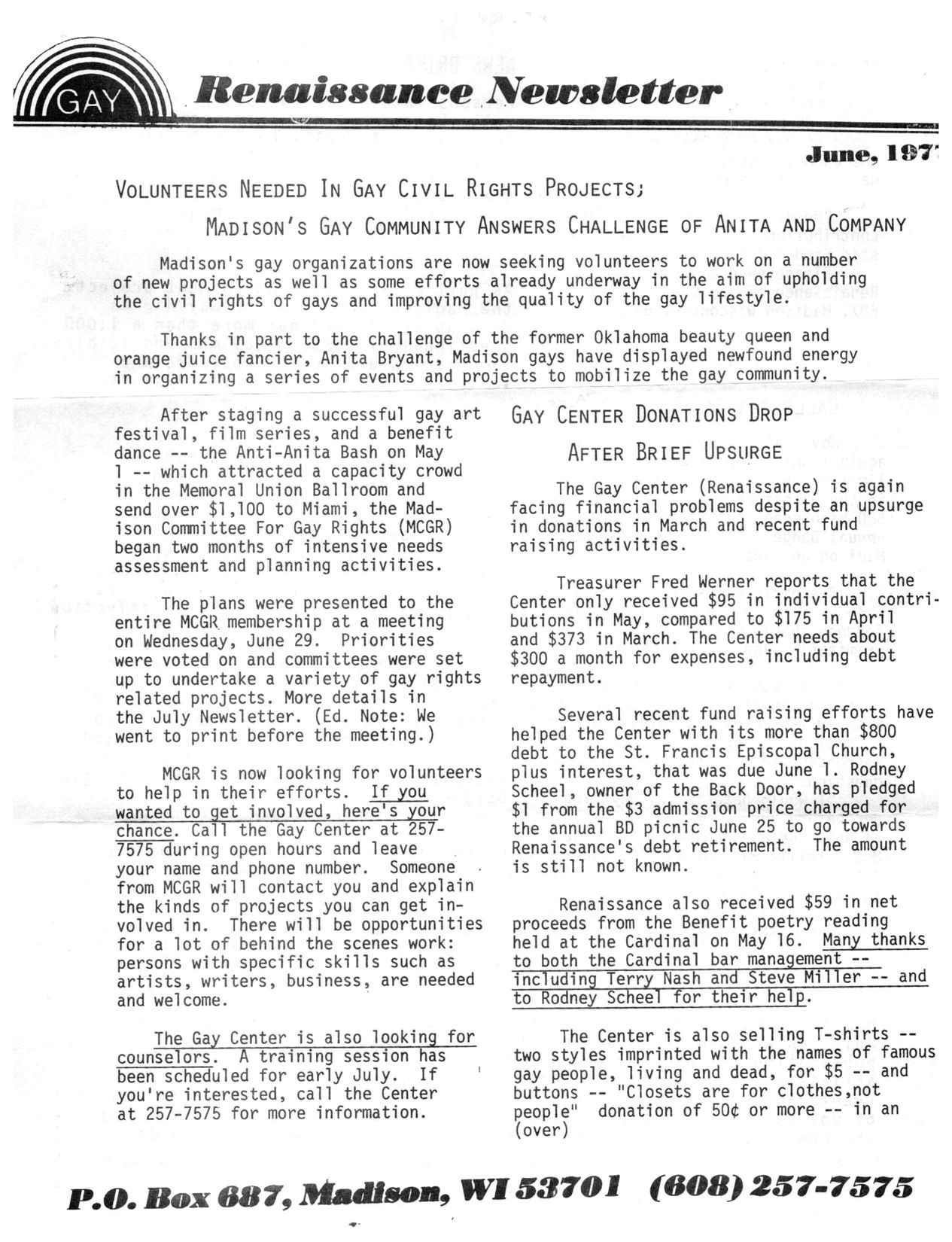
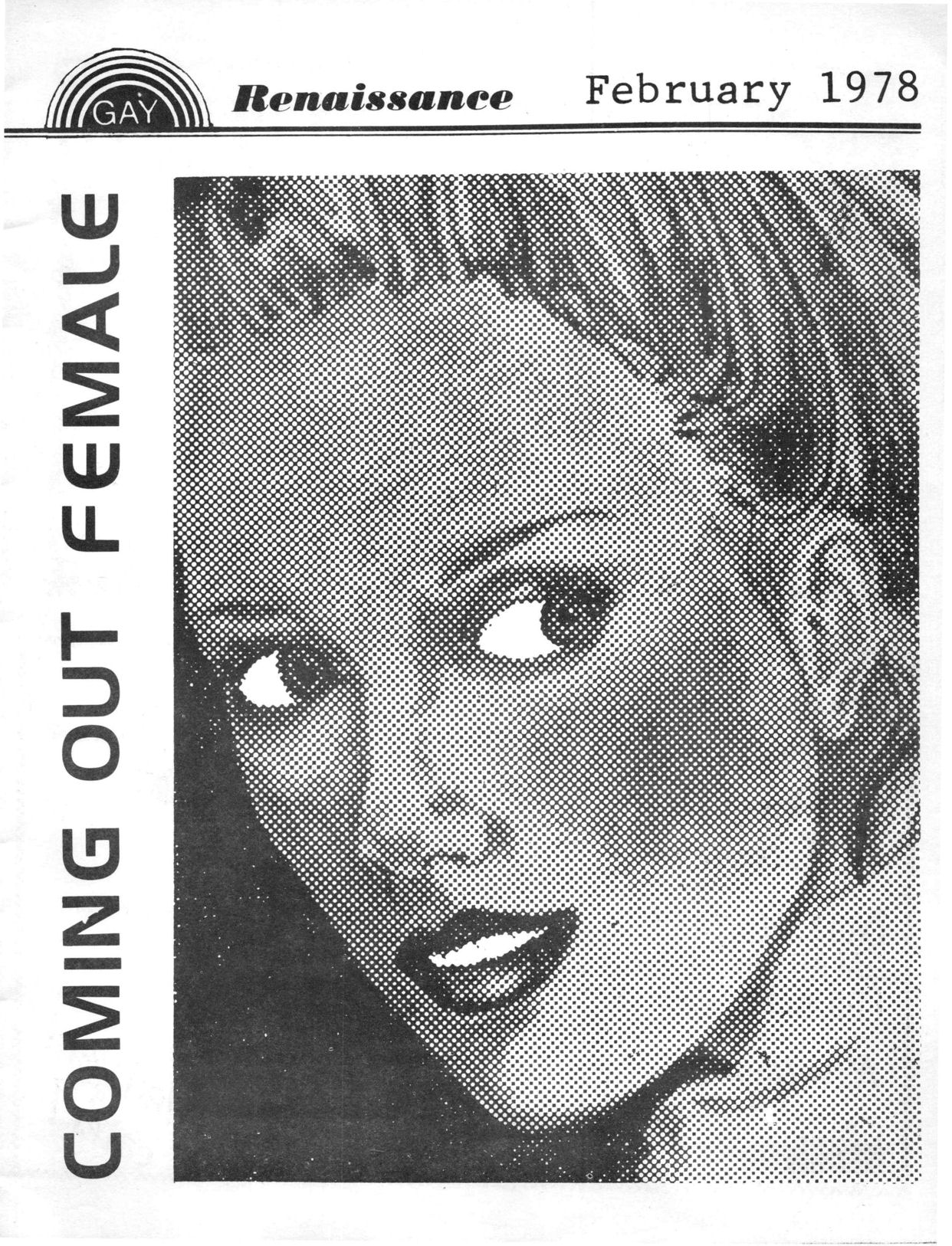
Renaissance also played an important role in developing LGBTQ communications in Madison. It published a newsletter for several years, providing information about community activities, political issues, health, organizational affairs and LGBTQ life.
The publication's name changed over time. The Gay Coordinator's Newsletter began appearing around the time Renaissance was incorporated in 1974. In 1976, it became Gay Renaissance, and it was subsequently replaced by The Gay Endeavor. The final known issue of The Gay Endeavor was published in March 1978. The City of Madison's historic survey identifies these publications collectively as the first known LGBTQ periodical series produced in Madison.
Surviving copies of Renaissance's newsletter collection provide an unusually valuable window into Madison's LGBTQ community during the mid-1970s.
Maintaining a community center and providing free or low-cost services required a dependable stream of donations and other revenue. Renaissance's newsletters reveal the financial difficulties faced by many grassroots LGBTQ organizations during this period. Its 1975 informational material noted that Renaissance was responsible for the coordinator's salary and was seeking tax-exempt status.
By 1977, the financial strain was becoming increasingly apparent. A November 1977 newsletter announced that Renaissance was beginning to accept classified advertising, because personal donations had declined. Advertising revenue was needed to continue production, as the newsletter had not been consistently published throughout 1977.
The exact end date of Renaissance of Madison is unknown. Surviving evidence indicates the organization survived until at least 1981.
Renaissance's work became part of a continuing chain of Madison LGBTQ organizations. In 1983, the Gay Center moved to 1127 University Avenue, where it continued to provide meeting space, administrative offices and community services. In 1985, the Gay Center reincorporated as the Madison Gay Resource Center and later became the Madison Gay and Lesbian Resource Center. That organization eventually merged with The United in 1998 to form OutReach, Inc., creating an organizational lineage that continues today.

INPUT ALWAYS WELCOME!
We are always looking for photos of the exterior and interiors of Bars and other Places, as well as information about ownership, activities and opening and closing background info about Places. We welcome your input and photos!
join our email list
Get WI LGBTQ History Project updates in your inbox.


